
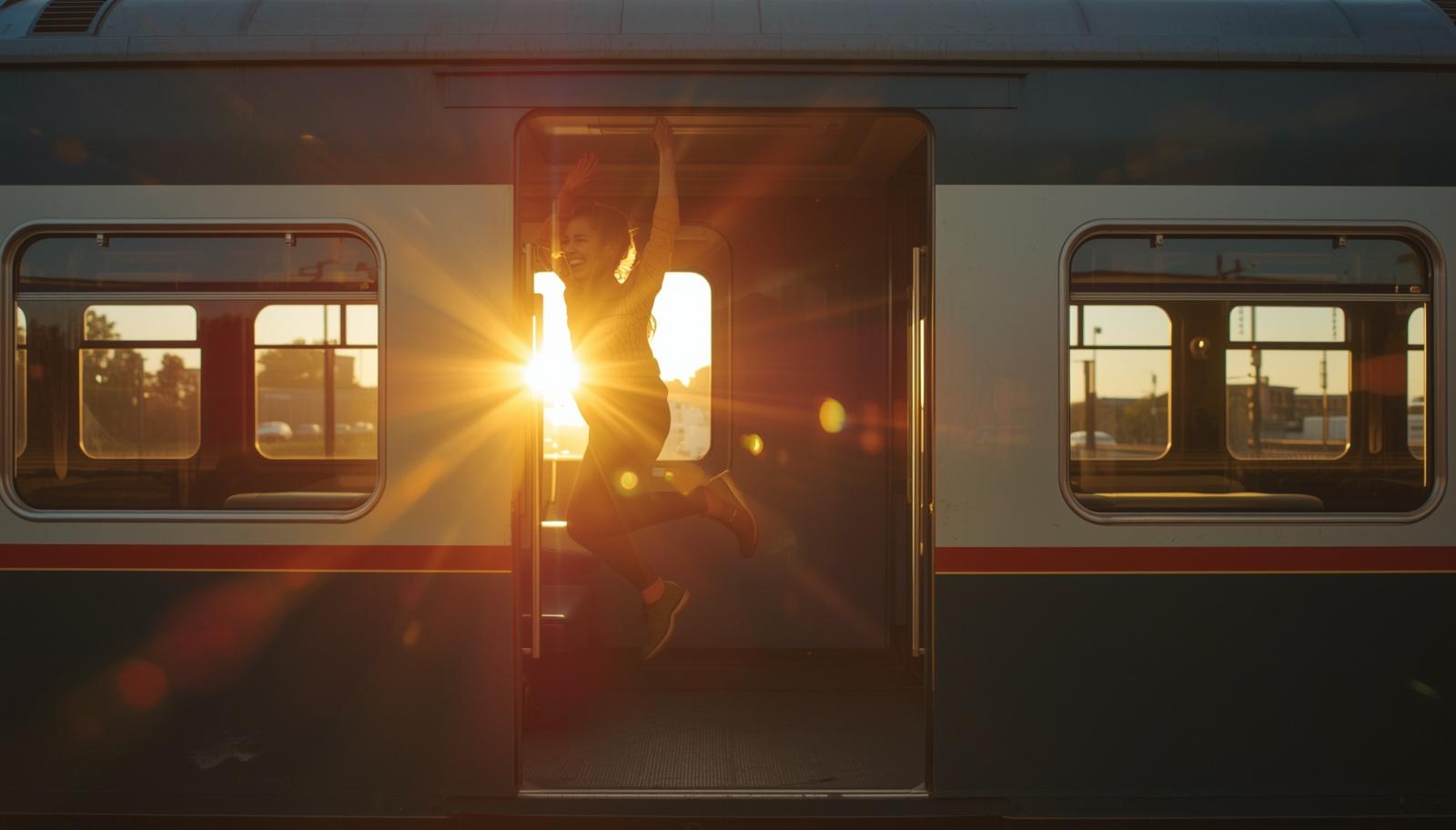
For many people, trains are part of everyday life. Why is it that when you jump inside a train carriage, you land back in the same place instead of falling backward? And what happens if you jump on top of the train instead?
When you jump inside a train carriage, you usually land in the same spot. This is due to inertia and relative motion. As the train moves forward at a certain speed, both the passengers and the air inside the carriage move with it. When you jump, your body temporarily leaves the floor but still retains the train’s forward velocity, so you continue “moving with the train” while in the air. By the time you land, your position relative to the floor has barely changed, making it appear as though you landed exactly where you started.
If the train suddenly accelerates or decelerates, the situation changes. Because your body maintains its original speed, a sudden stop may cause you to fall forward, while a sudden acceleration may make you shift backward. These outcomes are explained by the law of inertia: an object will maintain its state of motion unless acted upon by an external force.
Jumping on the roof of a train is entirely different. Although you initially retain the train’s forward speed when you leap, the surrounding air does not move with the train. Once you leave the roof, you are immediately met with strong air resistance, which gradually slows your forward velocity. As the train continues moving ahead, your relative speed decreases, causing you to land farther back—or even be thrown toward the rear of the train.
This phenomenon is essentially the combined effect of inertia and air resistance. Inertia allows you to keep the train’s speed when you jump, but the stationary air exerts drag that reduces it. Since the train keeps moving quickly, your position relative to the roof is no longer fixed, so you cannot land in the same spot as you would inside the carriage. This is why jumping outside a fast-moving vehicle is extremely dangerous: beyond the risk of falling, you are also exposed to intense airflow.
But what if the train’s windows are opened, allowing outside air to rush into the carriage?
In that case, the situation becomes more complex. Although passengers and the carriage still move forward with the train, the inflow of stationary air creates turbulence and drag. This reduces your forward speed slightly while you are in the air.
As a result, you would still land roughly in the same place, but with minor displacement or instability. The extent of this effect depends on the train’s speed and how wide the windows are opened: small openings cause little change, while wide-open windows at high speed let in stronger airflow, making you feel as though the wind is pushing you backward during the jump.
We leverage big data to bring you the most fascinating and mind-blowing trivia. Follow us for regular updates—prepare to be amazed while leveling up your knowledge.



The shelves of supermarkets are filled with an endless variety of alcoholic beverages, and as consumers we are accustomed to purchasing ready-made products. Yet one might wonder: is it truly possible

Many people have twin friends, and upon first meeting them, one often marvels at how similar they look. Why do twins resemble each other so closely? What leads to the formation of twins? Sperm

For many people, losing weight feels like a lifelong mission. In today’s world of abundance, food shortages are no longer a concern. Instead, overnutrition has led to widespread obesity. ###

Summer is hot, winter is cold. The seasonal changes we observe from childhood to adulthood greatly shape our lives. What force lies behind this fascinating phenomenon? The answer is the Sun. In

Atoms are the fundamental units that make up all matter in the world. They are so small that they cannot be seen with the naked eye, yet they are the building blocks of everything. At the center of

When taking antibiotics, patients are often instructed to complete the full course in order to reduce the risk of bacteria developing resistance. But why do bacteria become resistant, and what
Christianity, Catholicism, Orthodoxy and Protestantism Christianity is a faith centered on Jesus Christ, emphasizing salvation and the relationship with God. It is also one of the religions with

In the human world, rest and sleep are essential to life. Humans, mammals, and even most fish can conserve energy by remaining still. Yet in the vast ocean, there exists a group of creatures that can


Follow us for quirky updates, fun discoveries, and a front‑row seat to the weird and wonderful world we live in.