
All things in the world are composed of atoms, which are the fundamental units of matter. At the core of each atom lies the nucleus, containing positively charged protons and electrically neutral neutrons. These particles are tightly bound together by the strong nuclear force, forming a stable atomic nucleus. Surrounding the nucleus are negatively charged electrons, distributed across different energy levels in electron clouds. The number of electrons balances the number of protons, keeping the atom electrically neutral under normal conditions. When multiple atoms form chemical bonds through the sharing or transfer of electrons, they combine into molecules. In simple terms, protons and neutrons make up the heart of the atomic nucleus, while electrons accompany the nucleus externally. Together, they constitute the complete structure of the atom, and atoms further combine into molecules, creating the material world we see.
Electrons are fundamental particles carrying negative charge. Within atoms, they usually orbit around the nucleus, maintaining overall neutrality. However, when an external electric field or potential difference is applied, electrons can be driven away from atoms or set into motion within a conductor. This organized movement of a large number of electrons in a specific direction is what we call electric current. In other words, current is not an independent substance, but rather the macroscopic manifestation of electrons continuously moving through conductors or ionized gases. The microscopic motion of electrons, driven by an electric field, produces the macroscopic phenomenon of current, allowing energy to be transmitted through circuits.
When an external power source (such as a battery or generator) establishes a potential difference, it creates regions of high and low energy at the ends of a conductor. The electric field spreads through the conductor, pushing free electrons into motion. These electrons, which were originally moving randomly, become organized under the influence of the field, flowing overall from the negative terminal toward the positive terminal. As electrons continue to move, energy is transferred along with them, powering components in the circuit, such as lighting a bulb or driving a motor. Finally, the external power source continuously supplies energy to maintain the potential difference, ensuring the sustained flow of electrons. This is the complete process of how electric current operates.
Inside a thundercloud, the air is filled with water droplets and ice crystals, which are constantly colliding due to strong updrafts and downdrafts. These collisions are not merely mechanical contacts but involve charge transfer: when larger ice particles or droplets collide with smaller ice crystals, electrons often shift from one to the other. Typically, the smaller, lighter ice crystals lose electrons and become positively charged, while the larger, heavier particles gain electrons and become negatively charged. Because the heavier particles tend to sink, they accumulate near the bottom of the cloud, creating a region rich in negative charge. Meanwhile, the lighter ice crystals are carried upward by rising air currents, taking positive charge with them and forming a positively charged region at the cloud top. In this way, the thundercloud develops a layered charge structure: negative at the base, positive at the top, and a massive potential difference with respect to the ground.
The electric field generated by these electrons extends downward toward the ground, influencing the surface through electrostatic induction. The ground, normally neutral, experiences a redistribution of its free electrons under the strong field: electrons are repelled deeper or farther away, leaving behind a relative concentration of positive charge near the surface. This positive region is not due to protons escaping, but rather the absence of electrons, creating an area deficient in negative charge. As the potential difference between the negatively charged cloud base and the positively charged ground intensifies, the electric field strength approaches the critical threshold needed to break down air’s insulating properties.
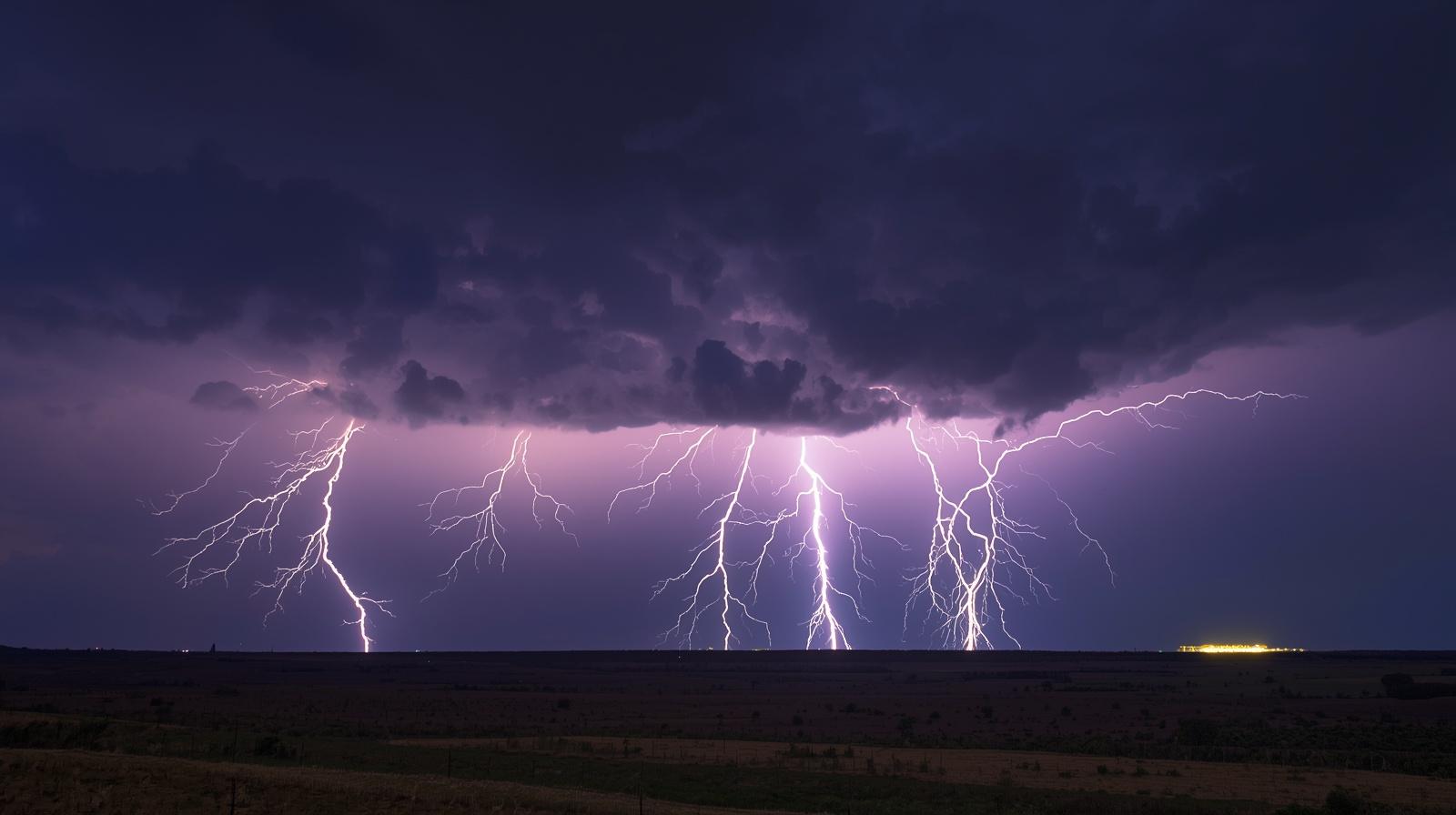
When the field strength exceeds the breakdown limit, air molecules become ionized, forming conductive channels. Electrons rush through these channels toward the ground, releasing enormous energy. Part of this energy appears as light: molecules, once excited, return to their ground states and emit photons, producing the brilliant flash of lightning. At the same time, the current heats the air to tens of thousands of degrees in an instant, causing violent expansion and generating shock waves. These shock waves propagate through the atmosphere as the sound we hear as thunder. Because lightning channels are long, sounds from different distances overlap, creating the rolling rumble of thunder.
We leverage big data to bring you the most fascinating and mind-blowing trivia. Follow us for regular updates—prepare to be amazed while leveling up your knowledge.



Whether bizarre and fantastical events or ordinary, trivial matters, they all appear in our dreams. Some dreams are so vivid that we remember them clearly after waking, while others vanish instantly

Many people have experienced hiccups — those sudden spasms that make us feel uncomfortable. If they occur at the wrong time, hiccups can be quite embarrassing. So why exactly do we hiccup? Does

Myopia is one of the most common vision problems worldwide, and many people rely on eyeglasses or contact lenses to improve their sight. In more socially and economically developed regions, the

We often forget different things, but many of them are ones we’d rather remember—especially when studying or learning, where newly acquired knowledge seems to slip away quickly. How does the human

Does vaccination mean injecting the virus into yourself? After all, it doesn’t necessarily cause illness. Even if someone becomes infected and later recovers, wouldn’t they also develop antibodies?

Whether at a dinner gathering with friends or chatting freely at a bar, alcohol often seems inseparable from social life. Yet we often notice a phenomenon: after a couple of drinks, some people’s

Cars are the daily means of transport for many people, and during a journey it is inevitable to encounter sudden situations that require braking. But what actually happens when a car brakes abruptly

In human appearance, hair is often the most striking feature. It not only shapes our image but also carries cultural and aesthetic significance. Yet not everyone can maintain a full head of hair over



Follow us for quirky updates, fun discoveries, and a front‑row seat to the weird and wonderful world we live in.