
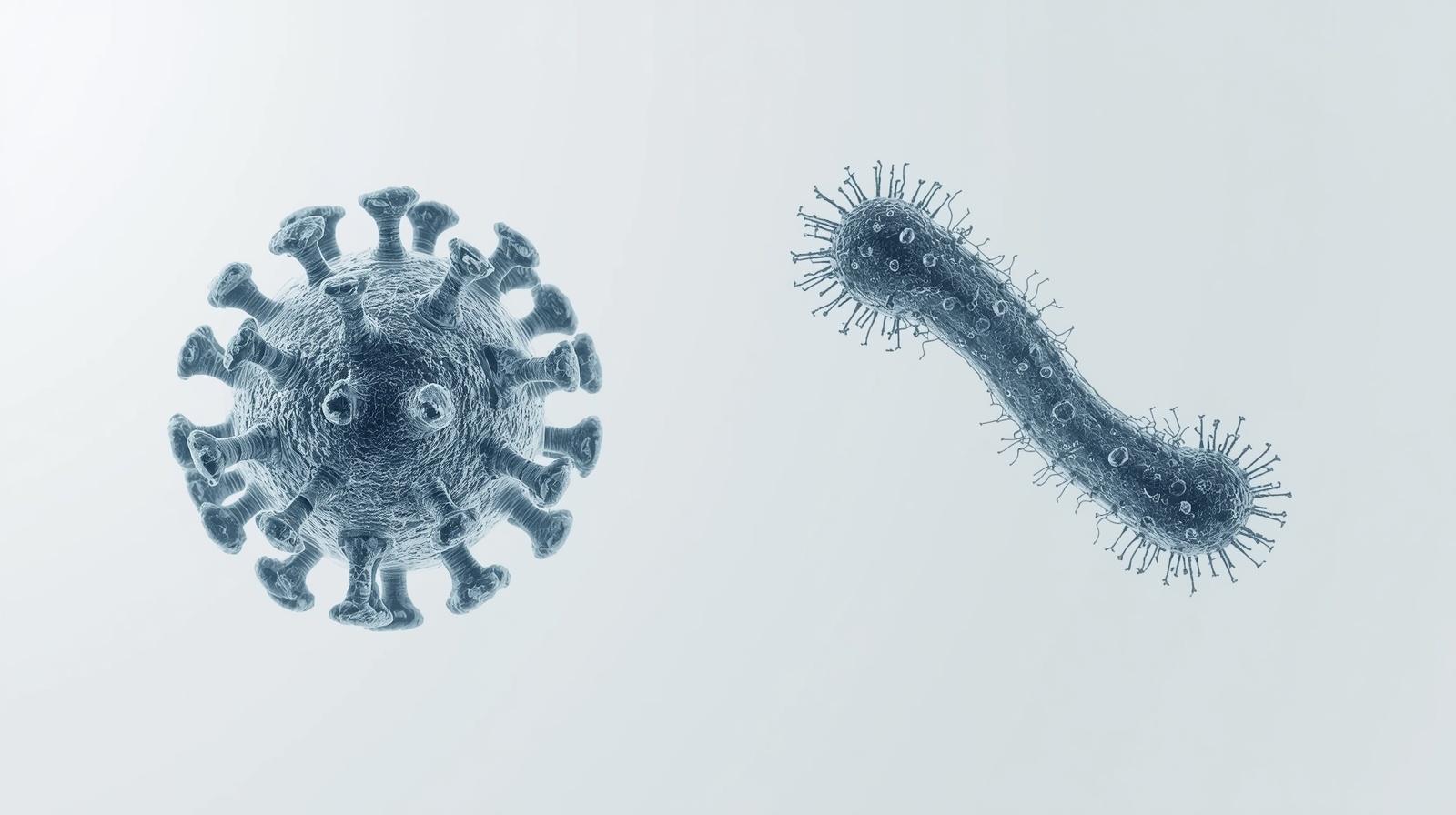
Bacteria and viruses are often mentioned together, both seen as frightening entities, but what exactly distinguishes them? Why do some people say bacteria can be treated, while viruses must be eliminated by the body’s own immune system?
Bacteria are prokaryotic organisms, meaning they lack a cell nucleus. When conditions are suitable, they can reproduce or divide on their own. In other words, bacteria are cells, though their characteristics differ from those of human cells. They are extremely small, reproduce very quickly, and can adapt to a wide range of environments. Viruses, however, are different. A virus consists of an outer shell that encloses DNA or RNA—in other words, it is genetic material protected by a shell. Viruses are not cells, so they cannot reproduce or divide independently like bacteria. They are smaller than bacteria, and their mutation and transmission rates are generally higher.
Bacteria can enter the human body through various routes: the mouth, wounds, the respiratory tract, the urinary tract, or injections. There are many types of bacteria, and different bacteria entering through different routes can cause different outcomes. Some bacteria may not cause disease when entering through one route but may do so through another, and vice versa. Once inside the body, if they can adapt to the environment and successfully evade or overcome the immune system, bacteria can multiply rapidly. They may then release toxins that attack human cells or damage tissues, causing inflammation. For example, Salmonella enterica serovar Enteritidis (a cause of gastroenteritis) usually does not easily cause disease if it enters through a wound. But if it enters through the mouth, although stomach acid can kill many bacteria (stomach acid destroys most bacteria, with only some species being acid-resistant), this bacterium’s acid resistance allows a small number to survive, reach the intestines, reproduce there, and release toxins, leading to diarrhea, gastroenteritis, and fever.
Viruses infect the human body in a way that is different from bacteria. When a virus enters the body, it attaches to and penetrates human cells, injecting its own DNA or RNA into them. The transcription and translation systems of the infected cell—normally used to produce the cell’s own proteins—are forced to manufacture viral proteins and replicate viral genetic material. As a result, the cell produces large numbers of virus particles within itself. Once a certain threshold is reached, the infected cell may undergo lysis (cell death), releasing virus particles to infect other cells, or it may release viruses through budding (the cell remains alive but its function is impaired). Through budding, virus particles are gradually released to infect additional cells. When a sufficient number of cells die or lose function, illness occurs. In other words, viruses do not reproduce by dividing themselves; instead, once inside the body, they exploit the host’s cellular machinery to replicate. Some viruses can even cause cancer. Oncogenic viruses can induce mutations in cellular genes, disrupt the cell’s gene regulatory systems, cause the loss of normal growth control, or interfere with mechanisms that suppress excessive cell proliferation. Ultimately, this leads to uncontrolled cell growth and the formation of cancer. Viruses are primarily eliminated by the body’s immune system, which must accurately recognize them. Medications can only inhibit viral entry into cells or interfere with viral synthesis, but they cannot directly kill viruses. This is unlike bacteria, which can be directly destroyed with antibiotics.
There are countless types of bacteria on Earth. Most are beneficial or neutral, with only a small fraction being harmful. Bacteria play vital roles in life. Beneficial bacteria aid digestion, synthesize vitamins, strengthen immunity, and suppress harmful bacteria. Examples include Lactobacillus, Bifidobacterium, and Streptococcus thermophilus. Neutral bacteria usually coexist with beneficial bacteria, helping maintain the balance of human health and the natural environment. They only become pathogenic under special circumstances. For instance, the human gut contains vast numbers of bacteria. If beneficial bacteria dominate, they suppress harmful bacteria, since space and resources in the gut are limited. When one group monopolizes resources, the other struggles to survive, and vice versa. Therefore, when the gut microbiota is already balanced and rich in beneficial bacteria, additional probiotic supplementation has limited effect, because space and resources are finite and even beneficial bacteria must compete for survival advantages.
Bacteria not only help maintain human health but also support the functioning of nature. Some bacteria decompose fallen leaves and animal carcasses, recycling resources. Others perform photosynthesis, producing oxygen for living organisms. Many bacteria can transform one substance into another. Humans often harness these processes for practical purposes, such as using bacteria to purify wastewater, ferment food, or brew wine and vinegar.
Another interesting phenomenon is that viruses are not all harmful to humans. Some beneficial viruses exist, such as bacteriophages. Bacteriophages are viruses that specifically infect bacteria. They do not infect human or animal cells, but instead target bacteria, regulating their populations and preventing certain bacteria from overgrowing and disrupting ecological balance. Scientists have long been researching ways to apply these viruses in medicine, using them to attack specific pathogenic bacteria and help treat disease. Because viruses carry genetic material, they can transfer genes between different organisms, thereby increasing biodiversity or driving evolution. In fact, viruses have played an important role in human evolution.
We leverage big data to bring you the most fascinating and mind-blowing trivia. Follow us for regular updates—prepare to be amazed while leveling up your knowledge.



All things in the world are composed of atoms, which are the fundamental units of matter. At the core of each atom lies the nucleus, containing positively charged protons and electrically neutral

The motor is one of the most important tools of human civilization, contributing greatly to the functioning of society. Electric fans, subways, electric cars, elevators—the examples are countless.

In daily facial care, many skincare brands and beauticians often emphasize the need for regular exfoliation. But what exactly are we removing when we exfoliate? Is it truly necessary? And what

“Cocktail therapy” is currently regarded as one of the most effective treatments for HIV/AIDS. Its core principle is the simultaneous use of multiple types of antiretroviral drugs in combination to

Durian, hailed as the “King of Fruits,” is renowned for its thick, spiky shell and its powerful aroma. Its appearance serves both as a natural defense and a sign of ripeness, while its distinctive

Stepping into the tropical rainforest, people are often astonished by the sheer size of its creatures: beetles as thick as a thumb, butterflies with wings as wide as a hand, and even frogs and ants

In human appearance, hair is often the most striking feature. It not only shapes our image but also carries cultural and aesthetic significance. Yet not everyone can maintain a full head of hair over

In the human world, rest and sleep are essential to life. Humans, mammals, and even most fish can conserve energy by remaining still. Yet in the vast ocean, there exists a group of creatures that can



Follow us for quirky updates, fun discoveries, and a front‑row seat to the weird and wonderful world we live in.