
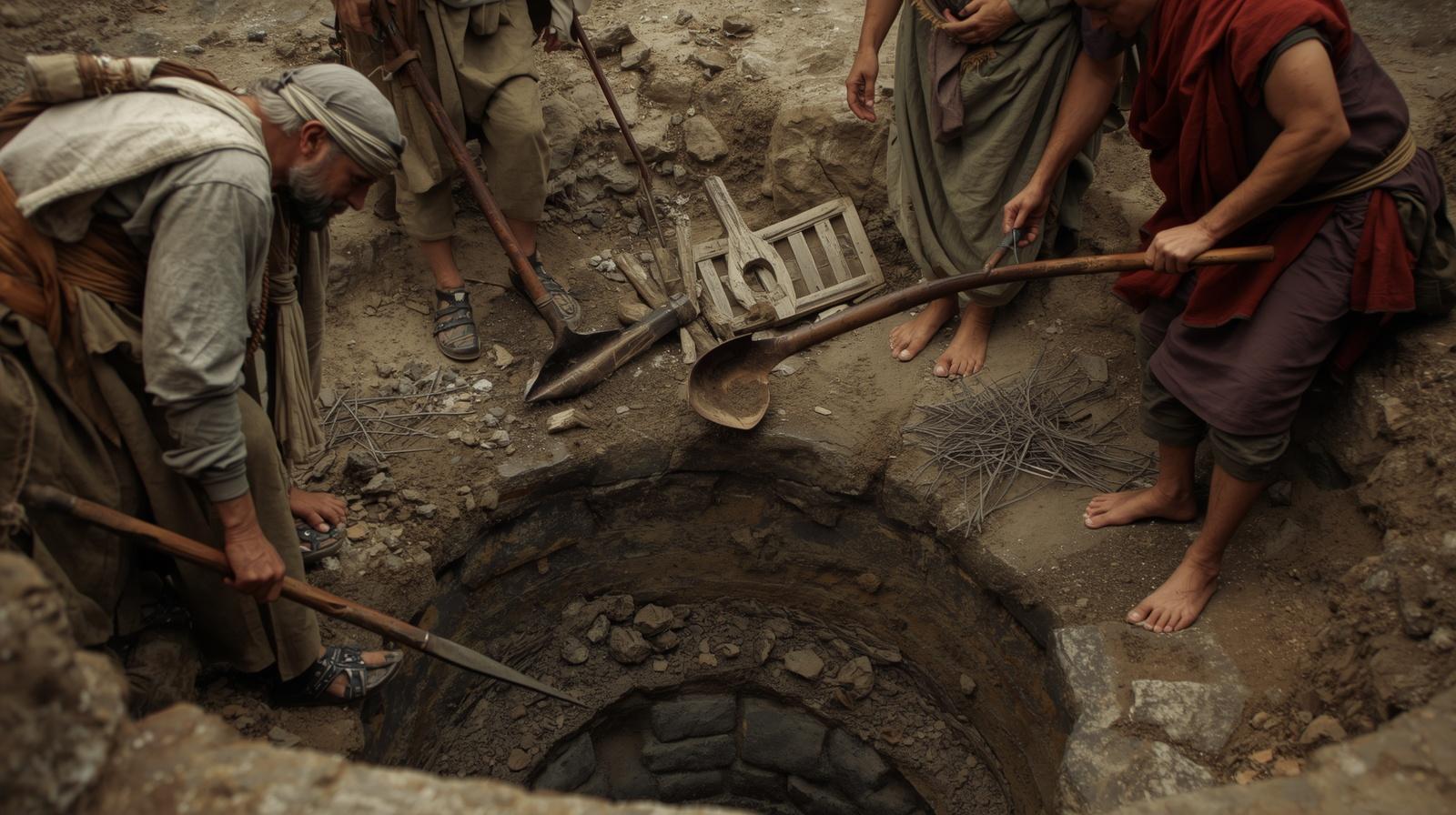
Looking back through history, we find that ancient people drew water from wells for daily use. But how exactly did they dig wells, and how did they know whether underground water was present?
Before ancient people began digging a well, choosing the right location was considered a crucial step. They typically relied on observing the natural environment to judge the presence of groundwater: for instance, in low-lying areas or near rivers, the soil was often more moist and vegetation grew more vigorously—both signs of abundant water. If the ground frequently showed mist or attracted swarms of insects, this could also suggest the existence of underground water veins. In addition to observation, they would often dig a shallow pit as a test; if water quickly seeped into the bottom, it indicated that the spot was suitable for deeper excavation. Although these methods were simple, through experience and careful attention, ancient people were able to identify proper sites for wells even without modern technology.
When ancient people dug wells, they relied primarily on human labor and simple tools, working step by step to excavate downward. They would first clear a stable working area around the mouth of the well, then use wooden shovels, stone axes, or later iron implements to remove soil layer by layer. As the shaft grew deeper, the excavated earth and stones had to be lifted out with ropes, pulleys, or a windlass, so that workers did not waste energy climbing in and out repeatedly. To prevent the walls from collapsing, they reinforced them gradually during the digging process—early wells were supported with wooden stakes or bamboo strips, while later ones were lined with stone slabs or bricks arranged in circular structures. Once they reached an underground water vein, moisture would seep into the bottom, and they would repeatedly clear away silt to keep the water clean. Although the entire process was time-consuming and labor-intensive, through experience and cooperation, ancient communities succeeded in building strong, durable wells that became central to village life.
Ancient well-digging techniques were never static; they advanced steadily as experience accumulated and tools improved. At first, people relied only on wooden shovels or stone implements to excavate, which often left the walls prone to collapse. Later, they began reinforcing the walls with wooden stakes or bamboo strips to increase stability. With the advent of bronze and iron tools, efficiency rose sharply, allowing wells to be dug deeper. In time, stone slabs and bricks were used to line the walls, preventing silt from seeping in and greatly extending the well’s lifespan. To ease the labor of drawing water, devices such as the windlass and the counterweighted lever were invented, making wells not only more durable but also far more convenient to use.
In many parts of the world, ancient well-digging techniques shared notable similarities:
We leverage big data to bring you the most fascinating and mind-blowing trivia. Follow us for regular updates—prepare to be amazed while leveling up your knowledge.



People often think the birds are stupid, yet parrots completely overturn this stereotype. They are not only capable of learning sounds but can also reproduce human speech with striking clarity,

Tattooing has been recorded since ancient times, often serving religious purposes, marking identity, or functioning as punishment. In more recent history, tattoos were also regarded as symbols of

During the Second World War, the Manhattan Project, led by American theoretical physicist Robert Oppenheimer, successfully produced the world’s first atomic bomb. The first test was conducted on July

The motor is one of the most important tools of human civilization, contributing greatly to the functioning of society. Electric fans, subways, electric cars, elevators—the examples are countless.

In discussions about food, we often hear the terms sugar, saccharides, starch, and carbohydrates. Are they the same thing? Saccharides and carbohydrates refer to the same category of substances.

For many people, losing weight feels like a lifelong mission. In today’s world of abundance, food shortages are no longer a concern. Instead, overnutrition has led to widespread obesity. ###

We often forget different things, but many of them are ones we’d rather remember—especially when studying or learning, where newly acquired knowledge seems to slip away quickly. How does the human

In human society, the most immediate differences often arise from appearance. Walking down the street or browsing through historical images, we find that human looks display astonishing diversity.



Follow us for quirky updates, fun discoveries, and a front‑row seat to the weird and wonderful world we live in.