
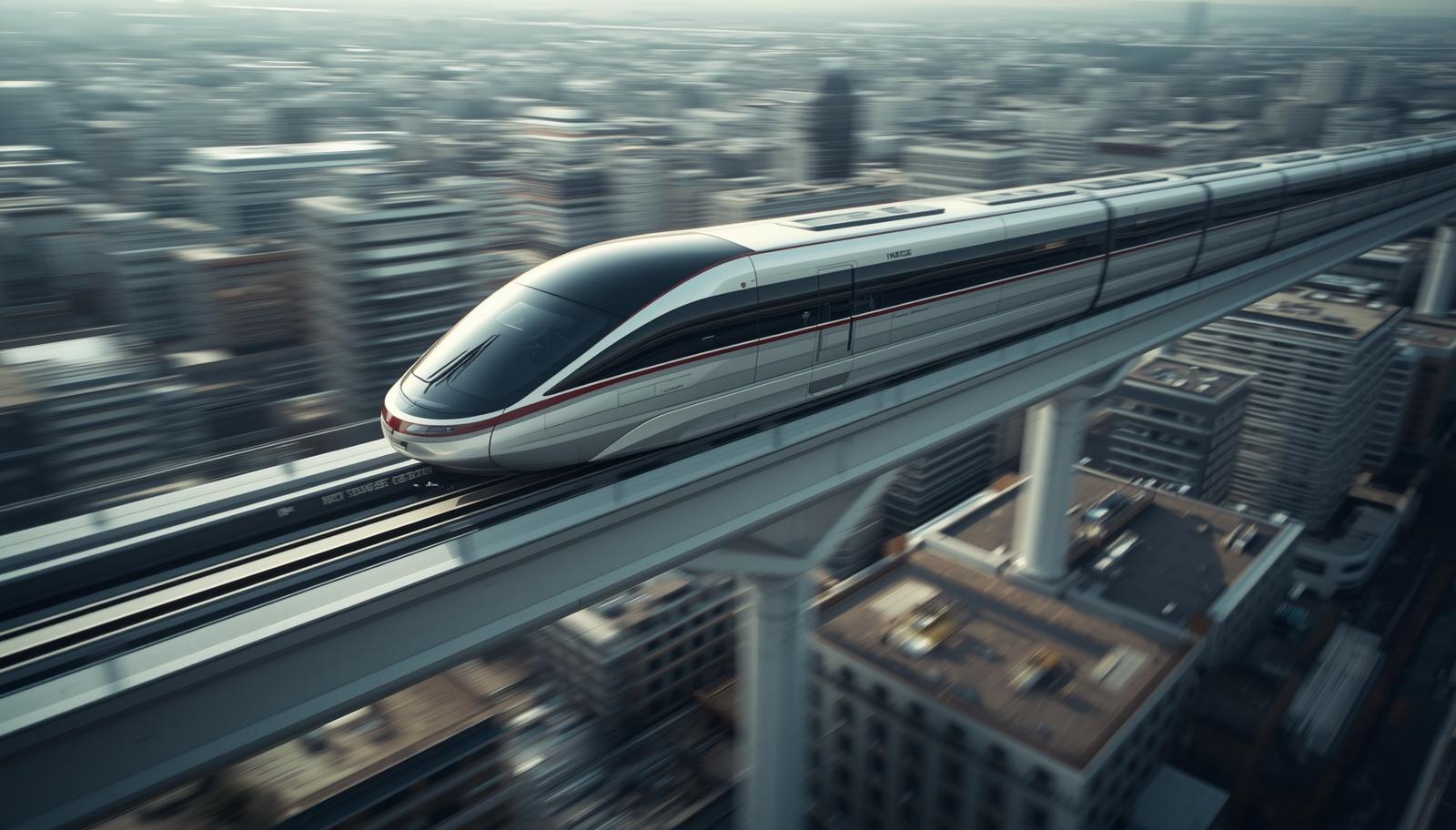
Magnetic Levitation (Maglev) trains are famous for their high speed, but how can such heavy trains float? And why do they need to float at all?
A maglev train is a high-speed transport system that uses magnetic forces to suspend the train above the track. It does not rely on wheels touching rails; instead, electromagnetic attraction or repulsion lifts the train and keeps it hovering above the guideway. Propulsion is provided by linear motors, with the track itself acting like a long motor that directly drives the train forward.
Currently, maglev trains are mainly divided into two types: Electromagnetic Suspension (EMS) and Electrodynamic Suspension (EDS), which can be described as attraction-based and repulsion-based systems respectively.
Electromagnetic Suspension (EMS) relies on the attractive force of electromagnets to hold the train just above the track. Powerful electromagnets are mounted beneath the train, while the guideway is lined with ferromagnetic plates. When the magnets are energized, they pull the train toward the track. Although it looks as if the train is sticking to the guideway, precise computer control keeps it hovering at a gap of about 8–10 millimeters.
If the train gets too close, the system reduces current to weaken the pull; if it drifts too far, the current is increased to strengthen it. This constant adjustment allows the train to remain stably suspended without touching the track. Because EMS is inherently unstable, it requires continuous electronic control, but its advantage is that the train can remain levitated even when stationary, without needing wheels for support.
Electrodynamic Suspension (EDS), on the other hand, uses the repulsive effect between magnets and conductors to support the train. Superconducting magnets are installed on the train, and as it moves, they induce currents in coils embedded in the guideway. According to Lenz’s law, these coils generate opposing magnetic fields, creating repulsive forces that lift the train. The levitation gap is much larger than EMS, typically 50–100 millimeters.
EDS is highly stable at high speeds because the repulsive force increases with velocity, allowing the train to remain suspended naturally without constant fine-tuning. However, at low speeds or when stationary, the repulsion is too weak to support the train, so wheels are needed until sufficient speed is reached for full levitation.
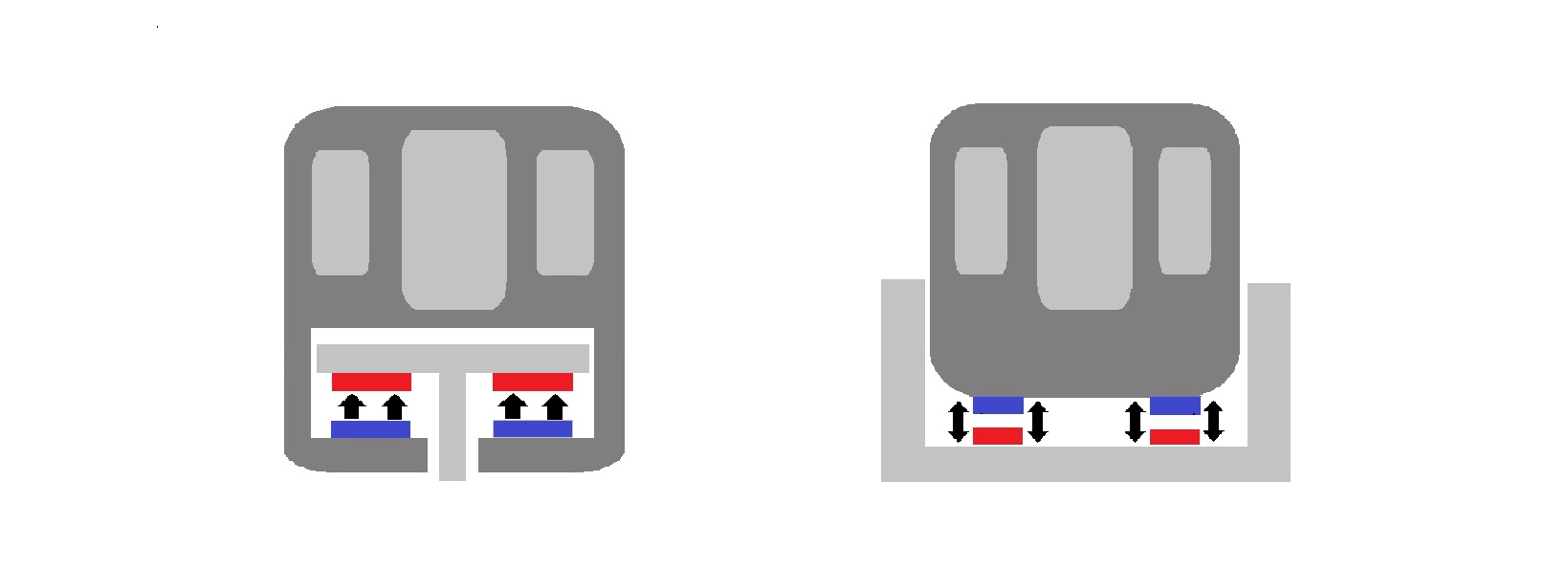 Electromagnetic Suspension and Electrodynamic Suspension
The reason maglev trains must float is to eliminate friction between wheels and rails. In conventional rail systems, steel wheels press against steel tracks, and as speed rises, friction and vibration increase, limiting maximum speed and creating wear and safety risks. By levitating above the track, maglev trains remove this contact entirely, breaking through the limits imposed by wheel-rail friction.
Advantages of levitation include:
Despite these advantages, maglev trains are extremely expensive to build. They require specially designed guideways with embedded coils and magnetic materials, constructed with very high precision. This means the cost per kilometer is often double or more compared to high-speed rail. Moreover, maglev systems cannot share existing rail infrastructure, so new stations, control centers, and entire networks must be built, further raising investment.
Maintenance is also demanding. While maglev avoids wheel and rail wear, its electromagnetic systems, superconducting magnets, and cooling equipment require constant specialized upkeep. Superconducting technology in particular must be kept at very low temperatures, consuming energy and adding cost. As a result, maintenance shifts from mechanical wear to advanced technological systems, and overall expenses are not lower than high-speed rail.
Maglev trains clearly offer superior speed and comfort, but their high construction and maintenance costs have limited widespread adoption. Today, they remain largely in demonstration use. Shanghai’s maglev line and Japan’s ongoing Chūō Shinkansen project are notable examples, yet large-scale global deployment is still far off.
Current adoption status:
| Item | High-Speed Rail | Maglev Train |
|---|---|---|
| Construction Cost | Lower cost per kilometer, mature technology | About twice the cost of high-speed rail per kilometer, requires dedicated guideway |
| Maintenance Focus | Wheel and rail wear, well-established maintenance practices | Electromagnetic systems, superconducting equipment, high technical threshold |
| Maintenance Cost | Relatively low, parts widely available | Overall higher, requires specialized upkeep and cooling systems |
| Level of Adoption | Widely operated worldwide, mature network | Limited demonstration lines |
| Advantages | Cost-effective, highly compatible | High speed, low noise, no friction |
We leverage big data to bring you the most fascinating and mind-blowing trivia. Follow us for regular updates—prepare to be amazed while leveling up your knowledge.



All things in the world are composed of atoms, which are the fundamental units of matter. At the core of each atom lies the nucleus, containing positively charged protons and electrically neutral
The discovery and application of electricity shocked the world and accelerated the development of human civilization. What exactly is electricity, where does it come from, and how does power
Radar has an exceptionally wide range of applications, capable of accurately determining an object’s position, distance, and speed. Its effectiveness becomes especially evident in conditions of low
Summer is hot, winter is cold. The seasonal changes we observe from childhood to adulthood greatly shape our lives. What force lies behind this fascinating phenomenon? The answer is the Sun. In

We often forget different things, but many of them are ones we’d rather remember—especially when studying or learning, where newly acquired knowledge seems to slip away quickly. How does the human

Stepping into the tropical rainforest, people are often astonished by the sheer size of its creatures: beetles as thick as a thumb, butterflies with wings as wide as a hand, and even frogs and ants

In human appearance, hair is often the most striking feature. It not only shapes our image but also carries cultural and aesthetic significance. Yet not everyone can maintain a full head of hair over

In everyday life, showering is a time for relaxation, cleansing, and even reflection. Yet there is one seemingly trivial question that often sparks debate: should you urinate while showering? Some



Follow us for quirky updates, fun discoveries, and a front‑row seat to the weird and wonderful world we live in.